


What Menopause Really Does to Your Skin


SKIN IN MENOPAUSE · ISSUE 01
You're not imagining it.
One of the things I hear most in clinic from women in their late 40s and 50s goes something like this:
My skin's just changed. Same routine, same products, and it's like they've all stopped working.
They haven't stopped working. Your skin has changed the rules.
Menopause skin is one of the most misunderstood things I see. So let's clear it up: what's happening, what helps, what's a waste of your money, and when I'll talk you out of a treatment altogether.
01 THE SCIENCE
What's actually going on
Oestrogen does far more for your skin than most people realise. It keeps collagen production ticking over, helps your skin hold on to water, keeps your barrier strong and supports blood flow to the skin.
When oestrogen drops through perimenopause and menopause, all of that slows down at once. And it doesn't happen gently.

Think of collagen as the scaffolding under your skin. Through your 30s and early 40s you lose a pole here and there. Menopause is when someone starts taking down whole sections at once.
02 THE SIGNS
What you'll probably notice

03 THE PLAN
The 3-step approach that actually helps
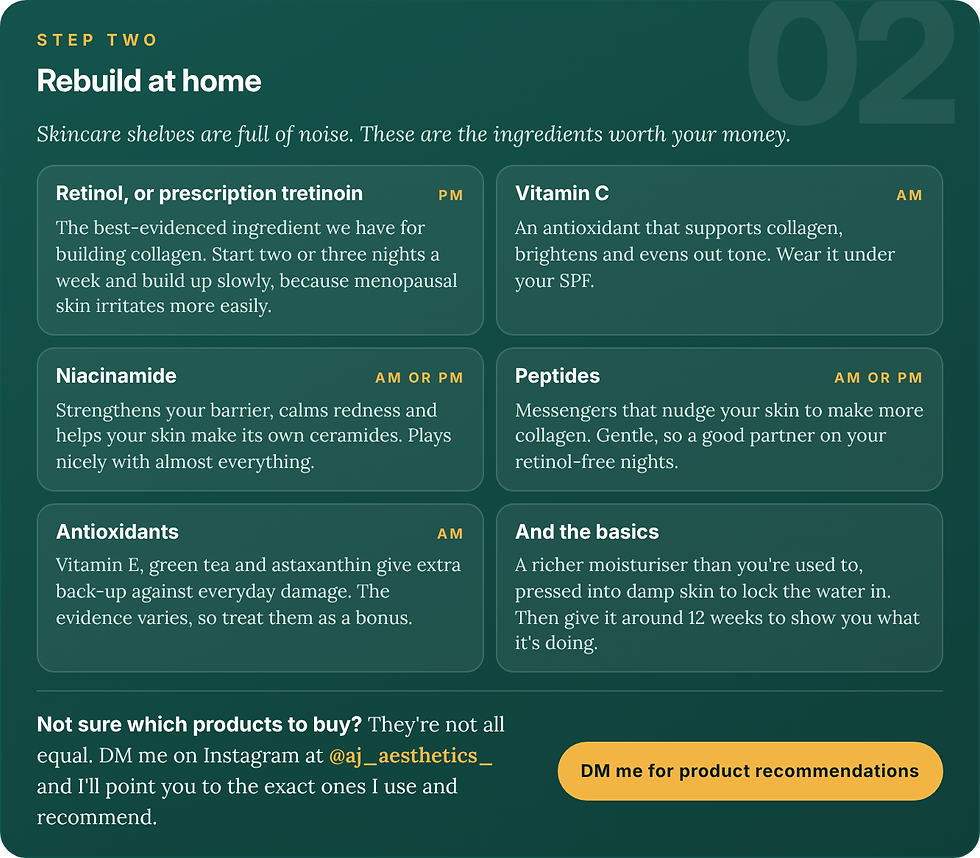
This is how I approach it with patients. The order matters.

Step 2: Rebuild at home

04 WHERE I DRAW THE LINE
When I'll tell you no

05 BEYOND THE CLINIC
The bits that happen outside my clinic


06 THE BOTTOM LINE
Your skin's changed. You haven't lost the game.
With the right protection, the right routine and the right treatments in the right order, your skin can look healthy, fresh and like you. Just a well-rested version.
Want to keep it? Download the full guide as a PDF.
Reading this for your wife, mum or sister? Send it her way.
Sources: British Skin Foundation, The impact of the menopause on your skin, with Dr Anjali Mahto (2022). Myung SK, Park Y. Effects of collagen supplements on skin aging: a systematic review and meta-analysis of randomized controlled trials. Am J Med. 2025;138(9):1264-1277.
This guide is general information, not personal medical advice. Treatments are only offered after a face-to-face consultation.


Comments